Thursday, February 24, 2011

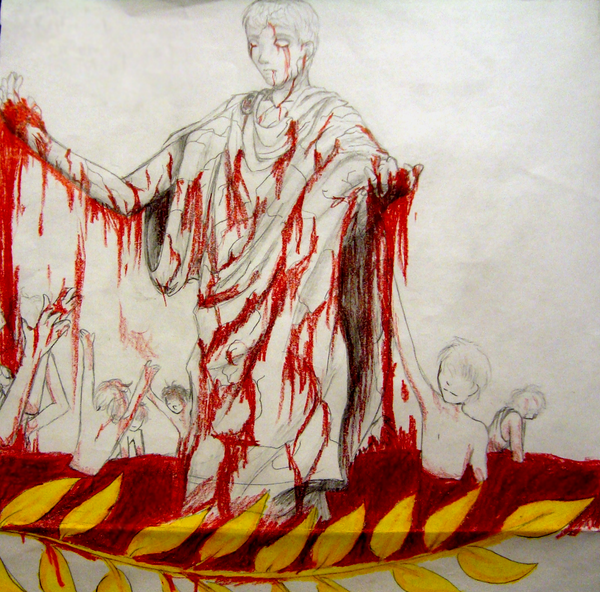
Brutus and Cassius's Private Exchange


For the Julius Caesar duo evaluation, my partner Anamika and I chose a passage on page 36, Act 1 Scene 2 , lines 130 – 174. The context of this passage is a private moment entertained between Cassius and Brutus, where Cassius makes an impulsive attempt to build Brutus’s resentment against Caesar up. This is in the intention to perhaps instill the thought of committing an act of rebellion within him (Brutus.)  

This passage was chosen to be performed as it represents an essential emotional and psychological turn, introduces the audience to the predominant theme of the play, foreshadows certain events and procedures as well as providing a lot of anxiety and characterization. Throughout the chosen lines, Cassius tries to infuriate Brutus by stating his opinion as well as (supposedly) many other Romans’ about who would be the better, more suited leader. Cassius refers to Caesar as a colossus, and to the people of Rome as “underlings” to this dictator. It is at this moment in time that Brutus becomes affected and commences to genuinely consider the substance in Cassius’s “persuasion.” The whole verbal exchange initiates a trail of thought that causes the audience to mentally foreshadow what will happen next. The general theme of the play is also established here. (Cassius convincing Brutus to rebel and save Rome, then there's the whole process of this, the conspirators kill Caesar and Brutus deals with the repercussions of his decisions.) This part that we are presenting also, clearly characterizes both Cassius and Brutus. The first is calculating and unscrupulous and persistent, almost Machiavellian. Brutus, on the other hand is overly pensive, naïve and patriotic, also he’s: pragmatic and contemplative and engrossed in his thoughts and current events. This passage is a fantastic amalgamation of the most significant components of this play, not to mention, this extract from the play institutes a lot of tension within the audience because of the myriad of possibilities: will Cassius manage to win over Brutus? Will Brutus realize what Cassius’s mind-frame is, or he fall for the false notes and sycophancy? What consequences will ensue if Brutus becomes a conspirator?


BRUTUS

    Another general shout!
    I do believe that these applauses are
    For some new honours that are heap'd on Caesar.

CASSIUS

    Why, man, he doth bestride the narrow world
    Like a Colossus, and we petty men
    Walk under his huge legs and peep about
    To find ourselves dishonourable graves.
    Men at some time are masters of their fates:
    The fault, dear Brutus, is not in our stars,
    But in ourselves, that we are underlings.
    Brutus and Caesar: what should be in that 'Caesar'?
    Why should that name be sounded more than yours?
    Write them together, yours is as fair a name;
    Sound them, it doth become the mouth as well;
    Weigh them, it is as heavy; conjure with 'em,
    Brutus will start a spirit as soon as Caesar.
    Now, in the names of all the gods at once,
    Upon what meat doth this our Caesar feed,
    That he is grown so great? Age, thou art shamed!
    Rome, thou hast lost the breed of noble bloods!
    When went there by an age, since the great flood,
    But it was famed with more than with one man?
    When could they say till now, that talk'd of Rome,
    That her wide walls encompass'd but one man?
    Now is it Rome indeed and room enough,
    When there is in it but one only man.
    O, you and I have heard our fathers say,
    There was a Brutus once that would have brook'd
    The eternal devil to keep his state in Rome
    As easily as a king.

BRUTUS

    That you do love me, I am nothing jealous;
    What you would work me to, I have some aim:
    How I have thought of this and of these times,
    I shall recount hereafter; for this present,
    I would not, so with love I might entreat you,
    Be any further moved. What you have said
    I will consider; what you have to say
    I will with patience hear, and find a time
    Both meet to hear and answer such high things.
    Till then, my noble friend, chew upon this:
    Brutus had rather be a villager
    Than to repute himself a son of Rome
    Under these hard conditions as this time
    Is like to lay upon us.

CASSIUS

    I am glad that my weak words
    Have struck but thus much show of fire from Brutus.

Monday, January 31, 2011

Learner Profiles


Im a FF profile, logic dominant. Its fairly bizarre because, even though I have a more significant access to the left side of my brain, I have quite a balanced usage of my gestalt side as well. I suppose that puts me to an advantage when doing analysis and assessing situations but sometimes messes me up on specifically logical (math) or gestalt (building) activities because I have to adjust and change the "dominant" side I utilize.

I learn best when I focus visually and deeply analyze details in information, this is because whenever Im not conscious of the specifics, it makes me feel ignorant or oblivious and almost stirs an immediate feeling of unease. I also do well when I am supplied with structured learning and data/information in a sequences, orderly manner. When things aren't organized, I lose track and get lost and dont know what to refer to and this causes for me to feel frustrated or have to rewrite the whole "lesson" in my own structured way. I do disagree with my profile a little because I don't believe showing me pictures will help me learn better in anyway, I mean: granted, I do respond to visual models but I also respond to audio and sensory models as well. I LOVE LISTS, I could make them, read them and alter them all day, because for me, when some thing is ordered I feel like I have control over it and haver a constant thing to refer to. This is why learning with our lesson, questions and activities listed is easier for me to follow because everything has a structure I appreciate.  I am emotionally expressive (physically - :P perhaps) and I love learning when I can write things down, remember them and organize them in a detailed manner. I love stress because it makes me more more efficiently and give more effort but I tend to lose my auditory skills under stress and not listen to anyone around me (which often proves to be a problem.) Im also a language lover, learning new languages is something thats a bit of a pastime, like spanish, portuguese, italian etc. This is why I love studying history and etymology in the classroom because it feels like a much more natural way of learning the signification of words.

I need to learn to work on my auditory skills because sometimes, when something tends to drag on (a movie, music video, class discussion etc.) I start having my own little conversation inside my head and thinking of other thing. Under stress, or when anxious regarding anything: I automatically lose the ability to listen to people or process anything that is said to me. Often this gets me in a reasonable amount of trouble because teachers and friends understand it as a lack of interest or want to participate.
Things that would help me learn is when I'm constantly asked questions, because I like answering things as it makes me feel like I have an opportunity to explain what I know and discuss it with other people. I also benefit from sitting at the front, reading aloud and talking about whats going on with people so that I can remain engaged the whole time. All of these things are just methods of keeping me interested on the task at hand. In the back, I would still retain all the information given but I would be more susceptible to distraction

I would like my teachers to know that as much as I will have my own little thing going on in my head, Im listening to everything and remembering every piece of information, its just that being able to think about something else helps me process things better. No matter how much it looks like I'm talking to people, laughing or looking in places not pertinent to the activity, I AM retaining all the information that is being given out. I have extremely good focus, I just need to be able to do something or engage in something else in order to properly "participate" in what is happening.  I analyze everything in my head until it makes sense and I know it inside out, its kind of an obsessive thing with me and I try my best to keep it to myself, so when you see my spaces out, or doodling, usually im writing down every little detail I feel relates to the topic. Also, when it looks like a use extensive vocabulary or words that perhaps should be simplified in order to better my writing, its an honest mistake. I read words and remember their roots and meanings and use them so, when I think of very simple things like "13 years gone by", my kind of immediately alters that to something like "the vicissitudes of 13 years." That why when I read comments about my vocabulary, or the way I structure a sentence: I feel really confused because I don't actually KNOW how to judge easy from hard. Also, on tests: questions need to be VERY specific and precise EXACTLY what it means. The questions on the Julius Caesar "pop quiz" ( the easy one) were fairly simple, but it gave me an unimaginable amount of trouble because the questions were not specific enough. For example "Did Cassius want all the power?" That is much too vague of a statement for me to deal with when there is a SPECIFIC answer. "Did Cassius organize the conspiracy in order to accumulate all the power for himself" would have been much simpler.

Monday, October 25, 2010

The Allegory of Sight: An Insight into the Renaissance


The Allegory of Sight (1618), was painted by Jan Brueghel the Elder. It was one of four works of art; each based one of the senses. Jan Brueghel the Elder was born in 1568 and died from cholera, in 1625: he was of Flemish origin and the son of Pieter Brueghel, another maestro of artistry. The Allegory of Sight was oil on canvas, a very multifaceted and intricate painting, burgeoning with vitality, exaggeration, fancy and vision. What seems like a hoarder's perspective of history is in reality, just an accurate depiction of his times; an amalgamation of myth and actuality. Jan B. lived and thrived in the late Renaissance, where innovative styles of art proliferated, embellished by breakthroughs and new techniques. One could only envisage that this, environment of perpetual metamorphosis and evolution, would be the muse for Brueghel, amongst many other artistes’ art, and more distinctly, for The Allegory of Sight. What I mean by this is that, his painting must have echoed his circumstances, his milieu, his era: The Renaissance. Correlations between elements in his art and life during this epoch are predominantly blatant, although some emerge more obscured than others. The individuals, the technicalities, the mythos and imagery: it was all about what was going on in the Renaissance: the objects are allegorical. They are figurative, representative of something, sometimes even metaphorical.  


Take the unclothed Venus as an example: she sits in this painting, perhaps cherishingly contemplating her son, cupid. Some distinctive features here are the fact that cupid has wings, as well as the mythical derivation of these two figures. Venus was a Roman Goddess, an emblem of love, beauty and fecundity. Fundamentally, she was a mythically comparable to Aphrodite, the Greek Goddess. During the glorious period of the Renaissance, artists acquired the autonomy to use their ingenuity and artistic acumen to commence to draw and paint more secular scenes. A painter could now prefer a peasant to a prince and an angel over Jesus for his works. Artists like Botticelli galvanized themselves and their ideas with Greek and Roman mythology. Paintings like La Primavera or Venus Anadyomene are centered on a more folkloric/mythic essence. This may be a substantial indicator as to: when the painting was made and the techniques and elements that were prosperous at the time. Venus might also be symptomatic of the independence in art happening in this era. Cupid, her son, is the god of desire and erotic love. He has wings, a distinguishing attribute that most individuals would not have, for the simple reason that it’s not possible, and yet… here he is evidently seen with angel wings. That signifies the opportunity and option for whimsy and the inconceivable in art. Also, you can effortlessly perceive the parallel between the two figures in this canvas: emblems of love, desire, affection, and fertility. This may be an illustrative way of indicating the foremost themes in art or life during the Renaissance. How painters, brimming with the yearning to charge their art with this new, profane, numinous, mystical, fictitious sensuality worked with representational figures to express this. 

The Allegory of Sight also comprises of numerous details, which refer to life in the Renaissance. The structural design, for example, is very gothic, a revival of what the Greeks had created. The sizeable hallway with a arched ceiling, the embellished curve of the corner-walls: this is all about what was happening at the time. The area itself appears grandiose but the specifics (details) in the architecture, such as lining and carving, is comparatively ordinary. This gives an understanding of what contemporary architecture was at that time. Not to mention the multitude of canvases that ornament the backdrop. You can see one of Madonna and Child encircled by a festoon of spring flowers, a portrait of Elizabeth the First and her husband, a scene with angels in the sky, wars and battles and an assortment of other canvases. To me, each depiction means something; it signifies a facet of life and culture at that time. Madonna and Child represent the function of religious conviction and belief in a society where artistic freedom is in place: the everlasting charisma of religious canvases and its societal magnitude. Elizabeth and her husband are English figures painted by a Flemish artist symbolize travel and trade: the communication and relations between countries, associations and ties and acquaintance, they represent an artistic and international relationship and awareness. Angels characterize the presence of religion and the flight of the imagination, intertwined and coexisting in a serene and innovative way. It represents the lighter, more whimsical side to life, belief, and work. War scenes represent reality and current events, societal and communal disagreements, relationships, and hardships. It’s about the actuality of life, how tribulations were solved at the time and perhaps the cause of these disagreements between individuals. It’s demanding to suppose that each feature and element would bear such a profound and precise relation to the Renaissance but it’s only rational that everything is there for a certain reason because all of these “objects and details” were part of Brueghel’s existence.
There are also individual objects with a correlation with what was going on during the Renaissance. There is a horde of sculpted busts in the background. Busts were tremendously popular in Ancient Greece and were also works of amateur artists and professionals in the Renaissance who sought to recreate the works and techniques of the Ancient Greeks. This represents the mindset and occupation of artists in the Renaissance. It also represents their discovery and familiarity with ancient cultures. There is an astrolabe and a telescope amongst other scientific instruments. This embodies development and inquisition. How, mathematicians, scientists and explorers began to develop scientific tools to see the world, to recognize what is unfathomable and to investigate unidentified sectors of our planet. The solar system, countries and trade maps: all the tools were indispensable to accomplish accurate depictions of these things. The exotic animals and the tapestries were an allusion to traveling in the renaissance: discovering new species, exploring the indefinite, importing and exporting goods. They allude to the riches being compiled, the growth and novelty! Countries in the Renaissance developed boats with which they could set out and explore new areas. Soon they developed trade and banking and were able to set up this import and export coordination. Countries in the Renaissance now had more assets, understanding and supremacy. This whole work of art encompasses years and years of development. How amazing is it that an image can so easily represent a whole life?

Artists are inspired by the world around them, its what they know: the world forms our desires, fantasies and ability to imagine. Art representing your world, how you live, what your life is like what is going on etc. All of this isn't new! These elements present themselves in today's art and media. Take contemporary art, filled to the brim with implausible skyscrapers, people in parachutes, couples, animals, airplanes, magnificent fake creatures and the kind. Every one of these things is inspired from daily life. What we can see, smell, taste, hear, perceive, sense. To know an artist’s life and environment all you really have to do is look at his painting.

The aim of every artist is to arrest motion, which is life, by artificial means and hold it fixed so that a hundred years later, when a stranger looks at it, it moves again since it is life.  ~William Faulkner 

Tuesday, October 5, 2010

Essential For an Unforgettable Epoch


The Renaissance was an era for artistic and intellectual development. It commenced in Florence, Italy : a realm for ideas. Postulations, experiments, hypotheses : Italy was the place to be. The Renaissance was a movement of progress that scoured through Europe in the 14 to 1600's. Often, this period in history will be recalled for its distinct advances in both scientific and exploratory methods as well as its governmental and political changes. Patronage, the Medici bank, the invention of the telescope etc. I believe that what made the Renaissance such a memorable time in history is the artists. They were the driving force behind this time period. Although, admittedly, there are a variety of peculiar factors that can be attributed to the singularity of the Renaissance, I think that art encompasses a multitude of the advances (intellectual: theoretical and analytical, scientific, mathematical) that were being made.

Prodigies such as Bruneslleschi, Da Vinci, Boticelli, Michelango and Donatello. Brunelleschi initiated the concept of linear perspective which was a significant expansion in creative possibilities concerning drawing and painting. This gave the opportunity for other artists to incorporate more realism into their pieces of art. Leonardo Da Vinci and his elaborate depictions of the human anatomy, his research into the accurate illustration of human limbs. There was Michelango and his paintings like the Creation of Adam. Paintings embellished architectural structures and served as ornaments to churches. The biggest dome (at the time), was internally adorned with magnificent works of art.

Often, a city's status would depend upon various factors regarding appearance and aesthetics of the area. Accomplished craftsmen were esteemed by their city-state and often prioritized by prosperous families seeking to offer patronage. Some of the most renowned canvases and distinguished artists originated from the Renaissance phase and remain until now, the cynosure of all aspiring artistes at expositions of galleria viewings. Everyone knows and recognizes the work of Da Vinci, the sketches of Boticelli and the statue of David. These artistic virtuosos and the products of their artistry remain embedded into our life, hundreds of years later.
This is why, I can firmly state that I believe artists were the most significant driving force behind what we call the Renaissance.

Monday, April 26, 2010

Post part one : The Creation


How are prejudice and bias created?


People who cannot find a reasonable answer for their problems and are in need of someone to blame create prejudice and bias. During the Nazi era, Germans were blaming Jews for all of the Fatherland’s misfortunes. The Jews were blamed for making the country lose the war, for stealing, taking money from others, being greedy and malicious. In the Boy in Striped Pajamas, Bruno’s tutor and family as portrayed Jews as unpleasant, ill-natured creatures that were at fault regarding all of Germany’s problems. Once this state of mind is established, the people being blamed persecuted and discriminated against in various forms such as dwelling separation, tags, announcements, propaganda etc.

Causes can also be classified into various sections such as: Anger. In The Boy in Striped Pajamas, Kotler expresses anger against the Jews for making his time harder, for ruining things for his country, for polluting his life and environment with their pest-like presence. Suppressed anger always leads to some sort of outburst often than not, if the end result is not controlled, it ends up being completely irrational if not “out of control” For example: People being angry for losing the war, keeping it in for so long, then going bankrupt, keeping it in, being robbed… and then comes the outburst. Who is to blame? Experience: In this case it would be fake experience. The entire Nazi party proclaimed to have, in the past been: betrayed, cheated, and deceived by the Jewish population, therefore causing a need for Jews to be separated from the rest of Germany so as to avoid the same experiences again. Take for example: Someone is attacked by a Jew on the streets: robbed of their possessions and belongings. Sometimes, this leads to developing a resentment of Jews, for fear that all of them are the same, looking out for a place where they can attack and rob you. So people decide to protect themselves from going through those experiences again, which results in isolating themselves from Jewish company and/or presence. Lack of empathy: in The Boy in Striped Pajamas, characters like the tutor, father and Kotler expressed no empathy of the situation of the Jews and were completely oblivious to their pain and suffering. The inability to feel creates a blockage between people that can then lead to things like bias, prejudice and segregation. The Nazi regime showed complete ignorance of other’s situation in the thought of: it didn’t matter or that’s fine because it’s them and not us. Lack of knowledge, in The Boy in Striped Pajamas, the tutor was completely misinformed about everything and hadn’t the least bit of knowledge about anything then what he was taught by the Nazi regime to be the truth. Father and mother didn’t know any better than to believe what the country was making them believe, therefore making them acceptant to the prejudice demonstrated in front of the Jews of Germany. Gretel didn’t know any better than to just follow what Kotler said and believe that it was correct and truthful. People supporting the isolation and bias acted blindly: in completely ignorance and in faith that what they were doing would be best for the Nation. Nobody held any knowledge whatsoever about the real cause and fixing of their issues. Fear of the unknown: In Bruno all the characters (apart from Bruno) seemed to hold (apart from loathing) a certain feeling of apprehension and dread towards the Jewish. This was, perhaps, because they feared fro the unknown, what these people were really like, what they really did and what actually happened if you let them into your lives. “If you were to find a friendly Jew, well BOY! Wouldn’t that be a first!?” Fear of difference: people who are afraid of difference create prejudice and bias, people who can’t fathom living in a place where everyone has their differences, people who fear that having diversity will bring chaos and misfortune to the world.


Culture and religion: Sometimes, the thought that one religion is superior to another can bring on discrimination and bias. In any circumstance, believing that you are better than someone else will make you treat them as someone of a lower kind, making them lesser, maybe sometimes not even human. Take the Boy in the Striped Pajamas, in the book, Judaism is looked down upon and considered something that nobody should be. Lack of open-mindedness: Nobody, whether it was in real circumstances, in the book or in any situation of unfairness and intolerance has open-mindedness. This closure of the mind, these thoughts that resonate “this is how it is and that’s that.” It becomes a giant dam, stunting any possible growth or progression and intensifying this “inevitability” that things are the way they are meant to be (with the bias and isolation.) But one of the biggest causes of widespread seclusion, chauvinism, partiality and discrimination is indoctrination. Propaganda, books, teachers, activists, speeches served as tools of indoctrination in real situations and in the book and acted as great influences to persuade people that all of this was right. All of these things are masterminds behind the beginning of bigotry and injustice towards other people. It’s just that we have to learn to think for ourselves and go against these things: we have to be like people from the Rose Blanche, like Bruno, like the Chambonnaise and all of the others who had to the courage to stand up to this.

Thursday, March 25, 2010

Luttrel - an epitome of wealth in the Middle Ages

The Luttrel Psalter is a book of psalms written in 1325 for Sir Geoffrey Luttrell of Irnham in Lincolnshire. (Channel 4 Luttrel Psalter: Sir Geoffrey) This manuscript was made up of 309 leaves of select parchment paper made of vellum (calf skin) and was written entirely in Latin. Historians believe that one scribe wrote the entire script whilst 3 or more painters would have worked on the images and paintings inside this book. Many times, as a paragraph is about to commence, the first letter will be illuminated with gold leaf and the size of it will be significantly increased. This manuscript holds depictions of everyday life in the Middle Ages and covers many of the aspects of living in these times. The Luttrel Psalter also contains ferocious paintings of monsters and babewyns. It is most likely that the scribe would have used feathers to write, as pens had not been invented in those times. This book stands as one of the most valuable manuscripts saved from the middle ages, as many did not survive to this day and time. The Psalter gives a great insight into the different features of life in the 13th and 14th century with it's many illuminated illustrations and representations of daily events and everyday scenes.

In these illustrations we can see a clear division of social status. Thus going back to the feudal system, where peasants were at the bottom and royalty at the top. Sir Geoffrey was a noble and therefore of quite elevated social ranking. At the dinner table scene, in the manuscript, we can see Sir Geoffrey, seated at the table whilst being served by his servants and butler. Two friars, employed to recite the psalms on a daily basis from the Luttrel Psalter are also seated at the dinner table. This also provides us with information towards the “cultural orientation” of Sir Geoffrey, we can tell from the presence of the monks that he is Roman Catholic. This image also provides details regarding the nutritional “value” of what the Nobles ate in the middle ages. On the table we can see plates of: eggs, roast meat, porridge-like cereal and maybe even suckling pig. The plates are made of silver, an indicator that he was extremely wealthy and could afford such expensive things. In the Luttrel Psalter, there are things to the evidence of the Sir Geoffrey’s wealth and power. The tapestries seen in the background of illustrations such as the dinner table and the horse and the gold leaf utilized in the illustrations suggest a lot of money and “power.” Nobles are always shown with elaborate clothing and headdresses indicating abundance in money to buy and create such detailed and intricate material. On the contrary, peasants in the images wore unadorned tunics with a set of plain leggings and flat-soled shoes. Servants and butlers show Sir Geoffrey as a man of affluence. Daily scenes also represent available technology in those ages: at the dinner table we can see bowls, knives and spoons. In the picture of the farmer in the field we can see a plough, also we can find: mills, armor, shields, tables, and other farming tools. The fact that there are metal plates suggests a blacksmith and tapestry hints towards the possibility of trade. As we can see in many of the depictions of peasants: agriculture was a big part of life in the middle ages. Animals such as cattle, sheep, pigs and chicken were farmed food and also used as farming tools. Scythes, knives, ploughs were often seen in images of peasants working in the fields.

The Luttrel Psalter was written for Sir Geoffrey and is more commonly believed to have been a tool to further praise and show off his wealth and power. In all pictures where he is painted, there are traces of gold leaf and he is always placed in focus. At the dinner table, you will find that the image overall, strongly resembles the last supper in which Jesus dines with his apostles. Is this a sign of him trying to portray himself as an equal to Jesus? It’s a possibility that this manuscript was made for the sole purpose of putting Sir Geoffrey Luttrell of Irnham in Lincolnshire in the limelight.

Sir Geoffrey passed away in 1345, leaving many estates and belongings to his family and employed servants and butler. The Luttrel Psalter lasts till this day, safely kept in the British Library, as a book of great insight into division of social ranking and life in the Middle Ages.


Wednesday, February 3, 2010

Steven McCurry Essay

Steven McCurry- Photography mogul
By Dakshina Chetti
January 19th 2010

Steven McCurry is a world-renowned traveler, photographer and humanitarian. His visits have reached across the globe to countries such as Cambodia, India, Vietnam, Yugoslavia, Mali, U.S.A, Afghanistan, Pakistan and beyond. With over 80 travels forwards and backwards across Asia, he is extremely familiar with this area of the world. McCurry’s photographs are profound and eloquent, unifying vibrant contrasts with an arrangement of distinctive angles. McCurry’s work deals with tunneling deep into the essence of the photographed, to extract as much emotion as possible. His photographs touch the hearts and minds of everybody with their poignant and emotive edge. In many of McCurry’s snapshots, the themes encompass of the daily pleasures and troubles of life, as well as the occasional lesson learned or thought to ponder.
“I’ve learned that humor is universal” quotes Steve McCurry, in one of his blog posts.
Many times his portraits have daunting features such as intense eyes, a big smile, a lingering gaze etc. These are yet other components of the distinctiveness of McCurry’s shots.
“Sometimes you look at somebody on the street and they just seem to have a strong presence, a look, a certain kind of attribute that comes out in the face.”
But what actually distinguishes his photos from that of others is that his images aren’t set up, just discovered and revealed in lens of the camera. Pure and unchanged, still so engaging and refined. What I mean is, the pictures look so genuine yet perfected at the same time. McCurry explores human exertion to handle the changes of the urban world, the unknown hardships of today, love in unexpected places, he captures the essence of living and sincerity in each and every image.
“Proxy-Connection: keep-alive
Cache-Control: max-age=0

st of my portraits are not formal situations; they are found situations”

He has received plenty of awards and many of his pictures have developed into renowned emblems of professional photography, such as “The Afghan Girl”, a portrait of an Afghan Refugee in a Pakistani camp. Her eyes resemble marbled plaques of jade while her face is swarming with subdued emotions, her stare follows you around. It’s almost indescribable, no doubt this image has come out as one of his most memorable accomplishments.


While rummaging through Steve’s website, where galleries of his photographs can be viewed, I came across two images that lingered in my mind. Usually, his images have their premeditated effect but none of his snapshots had startled me. The first picture I found was shot in Varanasi, India 1983, on what appears to be a day of the monsoon season. The sky seems clouded but a small blanket of baby blue can be spotted at the top corner of the image. A route of turbid water makes its grimy way around, flooding streets and houses. Nobody can be seen below the waistline, people can be spotted cowering along the borders of steps and ramps. Still, things seem to go as usual, with people waddling through the blurred water, cars and bikes pushing their way through. In the foreground, you can distinguish a small rickshaw with its wheels submerged underwater. A portly man sits inside the rickshaw, anxiously gazing at the buildings. His chest is covered with a red and yellow-checkered shawl, tied around both ends of the seat. This man's shoeless feet rest inside the chair, as a small shelter of shielding cloth acts as a shade above his oiled head. The driver isn't seated, he stands beside his bike, wearing an exasperated frown on his fatigued face, his eyes look down towards the water and his shirt is soaked with filth. With a hand gripping the steering wheel and another on the bike seat, it’s easy to see his desperate attempt to move his rickshaw forward. The man sitting down doesn't seem to be paying any attention to the driver’s efforts and instead, seems to peer into distance, observing his surroundings. I find it somewhat offensive that as the driver is so arduously trying to push his bike through the grimy sewage, the man just sits, seemingly oblivious. Through all this misery and misfortune, what with the apparent poor conditions and incoming flood, life continues. This picture shows that nothing has changed and everyone just has to deal with it and move on. Nobody will be helped or pitied, its life and everyone has their own. I love how this picture shows the pains and troubles of events in people's lives and how, while showing an image of a terrible mishap, teaches us one of the many morals of our existence: Life goes on, no matter what.

It's tough to compare my life with this picture because I usually end up feeling remorseful. My life is different in so many ways. Most of the time, when so much as a simple glass-crashing or knee-scraping accident happens to me, there’s always someone. Everything and everyone around me constantly is constantly there for support. I’ve never actually had to deal with a real issue on my own. Of course, the image and I have some similarities in the sense that, even if I am being supported, life continues for me too, either way. I feel embarrassed because I realize that generally, when I have an issue at hand, I tend to become easily aggravated if I cannot find ways to solve my problem so that I don’t have to deal with it to any further extent. It’s exasperating for me to even consider living through my dilemma and frankly, at that point it doesn’t usually matter to me that some people don’t have the choice to even consider extra support.
This photo is like a tiny wake up call, a reminder that, no matter how many barriers come to stand in my way, I can’t just let this affect my life so that I’m at a disadvantage. I have to move on and continue to live my life, solve my “crisis” and deal with it.
The second image I came across was taken in Bombay, India 1996. The photograph was shot from inside a car, most likely a taxi. The windows are smoggy and long trails left by raindrops strike across the blurry glass. A fraction of the front seat can be seen. If you look carefully, you’ll notice that part of the back window is open while the front window remains entirely closed. A young lady stands on the other side of the window, there is a small child resting on her hip, gazing into the car. The infant is drenched, his matted hair pressing against his damp forehead; his eyes resemble two globes and his expression is heart breaking. He appears vulnerable, fearful, curious and apprehensive, his small face ogling at the camera lens. No more than two years old, his miniature hands cower into the woman’s scarlet sari. He wears a sullied chemise that evidently hasn’t been washed for weeks, the white has faded away and been replaced with an unpleasant hue of raw umber. Buttons are missing from the shirt. The girl’s withered-looking fingers gently press against the window, her eyes seem sliced in half by the top of the window as she peers inside the car through the open space. This girl gives the impression of someone inquisitive, weary, pleading and despairing. Everything about her begs for help, her fingers remain pressed against the window. It’s as if she holding on to an opportunity, something better than what she has, a change in her life. From what I see I presume this is yet another begging family pleading for money and help in the streets of Bombay. I also deduce that this is her child and that they both live in poverty and work together in search of money.

It brings back memories from my trip to Bombay; this image is almost a déjàvu. I recall being in the taxi, with my money and camera, stuck in the rain and traffic. Beggars passing by were a heart-wrenching view. I clearly remember opening my window against the warnings of the driver in order to give some money. This picture brings back the irritation I held inside when I couldn’t comprehend why everyone was so insensitive. Our driver never opened his window either. These people were publicly mistreated, shunned and shooed. Everything was comparable to the picture, but then again, these just were my holidays. This image is this woman and her child’s life. I share in common, just a precious moment from the past but what I saw then; these people continue to live like this.

This is a theme of rejection, despair and gratitude. Beggars in Bombay are relentlessly discarded: cars drive away, people shout, windows close, honks blow. It’s hard to be unwanted by an entire society. In this image, the young woman has anguish shimmering in her eyes, she has nothing at all, no support, dependence or assurance of any sort. After this picture she will go back and continue her life as a beggar, going from car to car to car. It’s a lesson that things are different from either side of the window and that we have to value we have because it’s so much more than what some other people could have hoped for. We are some of the luckiest people alive and we should realize it.

Overall, Steve’s photos highlight the struggles and thrills lived by other people around us. Generally, McCurry’s photographs have a problem, or a conflict. Whether its: The Afghan War, India’s poverty, the Gulf War, poverty, droughts or even back problems.
McCurry pictures have taught me a lot about the art of taking pictures, such as: the need for fine color contrast, getting the right angle, digging deep into the people being photographed, extracting passion from every picture and capturing the more intense moments. I have come to understand that all of these elements are what define the influence of an image, such as: whether or not the picture will have its anticipated effect on its onlooker. I have also learned that color and angle can be used to alter and enhance a camera photo. Angles can balance out the foreground and background, laying more importance on the main object of the shot and color contrast can bring attention to a certain area of the photo or give the setting an ambiance/feel.
The great thing about photography is that it’s a way of changing lives through imagery. If a picture is taken well, it’s like experiencing the moment of the shot every time you look at it. Images can make us realize things, appreciate our world, comprehend each other, feel empathy and see things from an unbiased point of view. It can assist and improve our judgments, increase our knowledge and encourage us to see things another way.
Lingering photos are the greatest because you keep thinking about them and they incessantly come up in your mind. Enduring images are the ones with the most effect. Theoretically, the key to creating a long-lasting picture with a profound effect is to: Have good color contrast, detailed focus, an appealing angle, an exciting topic and a setting with feeling such as delight, struggle, pain, ecstasy or even grief.
‘For those who were desperate, my camera became an object of hope (...) Throughout my year-long coverage of the monsoon world, my strongest conviction was that I was involved in the fundamentals of life.’ - Steve McCurry
Reading a photo can sometimes take a lot of time, you have to: Look at the objects in the image, observe the surroundings, climate, mood, look at the people, expressions, actions, note the emotions, the smaller details, the angle, foreground and background and try to establish what is going on. An image can always be read as a story, or narrative and this helps me understand what is going on.
The people photographed in his images are generally in situations far different from ours, yet somehow we still relate to them. That is because of his work with feeling and emotion, the thing that all of us here on earth share. There is always the connection we have with his work because we can all recall sharing the same thoughts and moods shown his pictures. Everyone can relate to feeling a certain way therefore, we all establish a bond with his work.
‘Most of my photos are grounded in people, I look for the unguarded moment, the essential soul peeking out, experience etched on a person’s face.’ - Steve McCurry
His galleries reflect a collection of journeys, all the elements of good photography combine to tell a story of the image: what happened, what’s going on, why are things this way, what’s going to happen now? All these components to a long-lasting image reflect the tale of a journey, lived and experienced by the subject of the photograph.
Steve McCurry is by far one of the most influential cameramen I have ever seen, his images each tell a tale, and reach out to their viewers. A lot of them carry burdens of emotions and hold the tale of someone’s expedition in life to live and attain their goal.

Reference: Steven McCurry’s blog, stevemcurry.com